
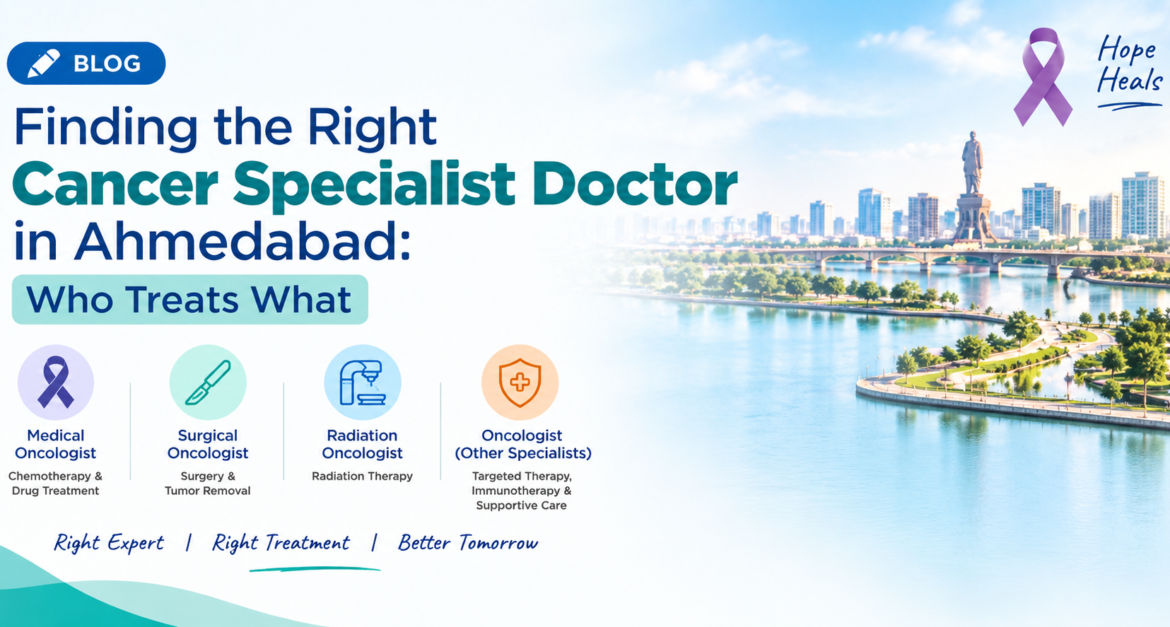
When a biopsy report comes back positive, most families start calling around for a cancer specialist doctor in Ahmedabad without knowing that “cancer specialist” is not one job. It is at least three, and sending your reports to the wrong one costs you time you would rather spend on treatment.
This guide explains who does what, how to verify that a doctor is genuinely qualified in oncology, what to expect from a first consultation, and when a second opinion is worth the trouble. It is written to be used, not just read.
The Three Kinds of Cancer Specialists
Oncology is divided by the type of treatment delivered, not by the type of cancer. Most patients eventually see more than one of these specialists.
Surgical oncologist
A surgical oncologist removes tumours and the lymph nodes around them. Their work covers the biopsy that confirms your diagnosis, the operation itself, and the reconstruction or preservation decisions that affect how you live afterwards.
Their qualification is an MCh or DNB in Surgical Oncology, taken after a general surgery degree. This matters more than it sounds. Cancer surgery is judged on clear margins and correct nodal clearance, both of which are decided in the operating room and cannot be corrected later.
Medical oncologist
A medical oncologist treats cancer with drugs: chemotherapy, targeted therapy, immunotherapy and hormonal therapy. They manage the dosing schedules, the side effects, and the decisions about when to continue and when to change course.
Their qualification is a DM or DNB in Medical Oncology. If you are told you need chemotherapy before or after surgery, this is the doctor who will plan it.
Radiation oncologist
A radiation oncologist uses precisely targeted radiation to destroy cancer cells, either as the main treatment or alongside surgery and drugs. Their qualification is an MD or DNB in Radiation Oncology.
Many patients are surprised to learn that radiation planning is a detailed technical process involving simulation scans and dose mapping before a single session begins.
Which Cancer Specialist Doctor in Ahmedabad Should You See First?
In most solid tumours, the surgical oncologist is the natural first stop, because the biopsy, the staging and the decision about whether an operation is possible usually come first. In blood cancers such as leukaemia and lymphoma, a medical oncologist or haemato-oncologist leads from the beginning.
If you are unsure, do not spend weeks deciding. Take your reports to any qualified cancer specialist doctor in Ahmedabad. A good one will tell you honestly if a colleague should lead your case, and will often arrange that referral directly.
The most reassuring answer you can hear is that your case will go to a multidisciplinary tumour board, where all three specialists plus a radiologist and pathologist review it together before anything is decided.
The Specialists You Never Meet, But Who Decide Your Treatment
Two doctors shape your plan more than almost anyone, and most patients never see either of them.
The pathologist examines your biopsy tissue and determines the exact cancer type, its grade, and the receptor or molecular markers that decide whether targeted therapy will work. An inaccurate pathology report sends the entire treatment plan in the wrong direction, which is why second opinions on slides are sometimes requested even when the clinical plan is not in question.
The radiologist reads your CT, MRI or PET-CT and establishes your stage, which in turn decides whether surgery is the right first step.
Alongside them you may meet an onco-anaesthetist for complex surgery, a palliative care physician for symptom control at any stage of treatment, an onco-dietitian, and a counsellor. When you ask about a hospital’s team, ask about these people too.
How to Verify a Doctor’s Credentials in Five Minutes
Anyone can be described as a cancer expert on a website. Here is how to check.
- Look for an oncology super-speciality degree. MCh or DNB in Surgical Oncology, DM or DNB in Medical Oncology, MD or DNB in Radiation Oncology. An MS or MD alone is a base degree, not an oncology qualification.
- Check the public register. The Gujarat Medical Council and National Medical Commission registers are searchable online and confirm that a doctor is registered to practise.
- Ask where they trained. Fellowships and training at recognised cancer centres are a reasonable signal of depth.
- Ask about volume in your cancer. “How many cases like mine do you treat in a month?” is a fair, normal question. Experienced doctors answer it comfortably.
- Check hospital affiliation. A specialist attached to a dedicated cancer centre has access to the pathology, imaging and tumour board support that complex cases need.
What a Good First Consultation Looks Like
A first consultation with a cancer specialist should leave you with more clarity than you walked in with. Expect the doctor to review your actual scans and slides rather than only the typed reports, explain your diagnosis and stage in plain language, lay out the options including the ones they are not recommending, and give you a realistic picture of side effects and recovery time.
To get the most from it, bring:
- Original reports, imaging CDs, and biopsy slides or paraffin blocks
- A complete list of your current medicines and doses
- A short family history of cancer with ages at diagnosis
- Your insurance or scheme documents
- A relative or friend to listen alongside you
- Written questions, so nothing is forgotten in the moment
If a consultation ends without you understanding your stage, your options and your next step, that is reason enough to seek another opinion.
When to Get a Second Opinion
A second opinion is not a sign of distrust. In oncology it is routine, and in some situations it is strongly advisable:
- The diagnosis is rare, or the pathology report is described as borderline or uncertain
- You have been advised extensive surgery, and want to know whether a less extensive option exists
- You have been told nothing can be done
- Surgery, chemotherapy and radiotherapy are being recommended in an order you do not understand
- The plan was offered before staging was complete
A genuine cancer specialist shares your reports willingly. Every document belongs to you, including your slides and scans. Reluctance to release them says more than any credential.
Choosing a Cancer Specialist Doctor in Ahmedabad You Can Stay With
Cancer care continues for years through follow-up scans and consultations, so practical considerations are not trivial. Can you reach the clinic comfortably during treatment, when fatigue is real? Does the doctor explain things in the language your family speaks? Is there someone reachable between appointments when a side effect worries you at night?
The right specialist is qualified, experienced in your specific cancer, supported by a proper multidisciplinary team, and someone you can talk to honestly for the length of the journey.
At Airavat Cancer Care, our team of qualified cancer surgeons treats patients according to current national and international protocols, with an emphasis on evidence-based practice and transparent communication. We welcome second opinions and will always share your reports with you.
For a wider view of how to compare centres rather than individual doctors, read our companion guide on choosing the best cancer hospital in Ahmedabad, which includes a seven-point checklist and the questions to ask on your first visit. You can also browse more patient guides on our blog.
Talk to a Cancer Specialist Doctor in Ahmedabad
If you have a recent biopsy or scan report and are unsure what it means or who should treat it, bring it in. We will explain your diagnosis, your stage and your realistic options in language you understand, and tell you honestly if another specialist should lead your care.
Call +91 9104462944 or book a consultation with our surgical oncology team in Ahmedabad. Second opinions welcome.