
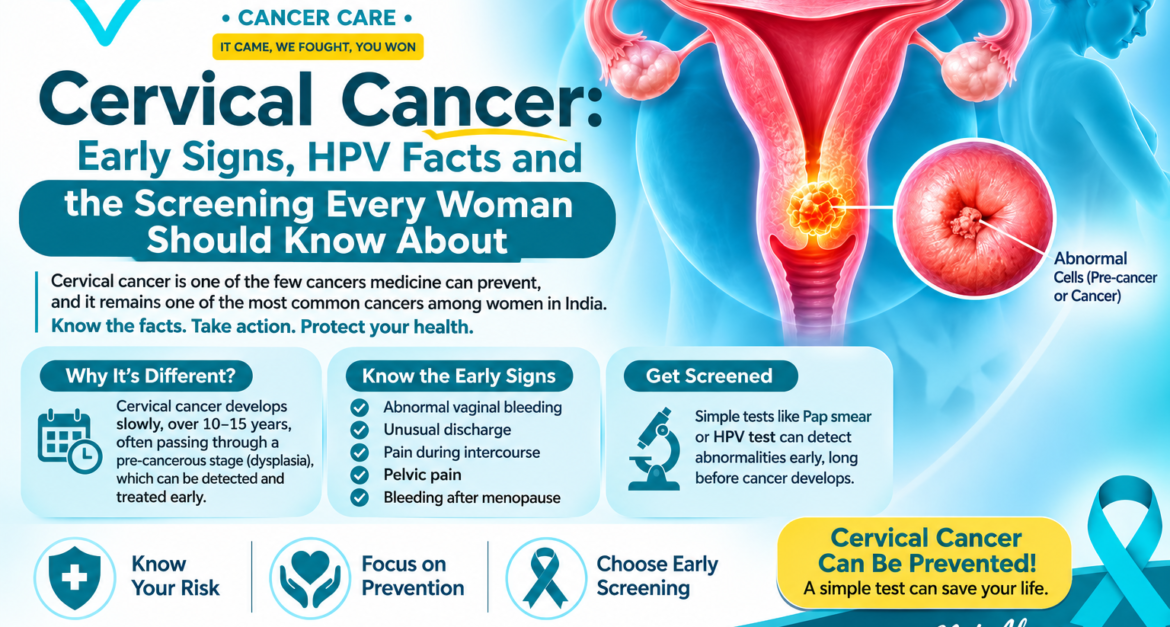
Cervical cancer is one of the few cancers medicine can genuinely prevent, and it remains one of the most common cancers among women in India. That gap between what is possible and what actually happens is almost entirely a gap in information. Most women who develop it were never screened, and many never knew screening existed.
This guide explains what causes cervical cancer, the early signs of cervical cancer that are routinely dismissed as ordinary gynaecological problems, how screening works, and what treatment involves. It is written for women making decisions about their own health, and for the families who often make those decisions with them.
Why Cervical Cancer Is Different From Most Cancers
Most cancers appear without warning. Cervical cancer does not.
It develops slowly, usually over ten to fifteen years, passing through a pre-cancerous stage called dysplasia or cervical intraepithelial neoplasia long before it becomes cancer. That stage is detectable with a simple test and treatable with a minor procedure.
This gives cervical cancer a property almost no other cancer has: a long, visible, treatable warning period. A woman screened regularly is very unlikely to develop advanced cervical cancer, because the abnormality is found and removed while it is still not cancer.
The reason the disease remains common in India is not that it is hard to catch. It is that screening rates are low.
It is worth sitting with what that means. A woman diagnosed with advanced cervical cancer has usually been carrying a detectable, treatable abnormality for a decade. Nothing about the biology failed her. The opportunity simply went unused, often because nobody told her it existed, or because a symptom was treated as an infection for two years without anyone examining the cervix properly.
HPV: The Cause, Explained Without the Myths
Nearly all cervical cancers are caused by persistent infection with high-risk types of human papillomavirus. Understanding HPV properly removes most of the fear and all of the shame around this diagnosis.
HPV is extremely common
A large majority of sexually active adults encounter HPV at some point. It is not a marker of promiscuity, carelessness, or anything a woman did wrong. It is close to a universal exposure.
Most infections clear on their own
The immune system clears the great majority of HPV infections within one to two years, with no treatment and no consequences. Cervical cancer develops only in the small fraction of cases where a high-risk HPV type persists for years.
Persistence is the real risk factor
What matters is not catching HPV but failing to clear it. Factors that raise the risk of persistence include smoking, a weakened immune system, long-term immunosuppression, and HIV infection. Smoking in particular roughly doubles the risk, which many women are never told.
A positive HPV test is not a cancer diagnosis
It means a high-risk type is present and you need monitoring, not that you have cancer or will get it. The entire purpose of follow-up is to catch persistence early.
Early Signs of Cervical Cancer That Get Dismissed
Early cervical cancer frequently causes no symptoms at all, which is exactly why screening matters. When symptoms do appear, they are easy to attribute to something else. See a gynaecologist if you notice:
- Bleeding after intercourse, which is the single most commonly ignored sign
- Bleeding between periods, or periods that become noticeably heavier or longer
- Any bleeding after menopause, which always requires investigation
- A persistent vaginal discharge that is watery, blood-tinged, or foul-smelling
- Pelvic pain that is new, persistent, or occurs during intercourse
- Pain in the lower back or legs, swelling in one leg, or unexplained weight loss in more advanced disease
None of these symptoms proves cancer. Infections, fibroids, polyps and hormonal changes cause them far more often. But all of them need examining rather than waiting out, and post-menopausal bleeding in particular is never normal.
Screening: What Actually Protects You
Two tests do the work, and they are often done together.
The Pap smear
A Pap smear collects cells from the cervix and examines them for abnormal changes. It is quick, done in an outpatient clinic, and mildly uncomfortable at worst. It detects changes before they become cancer.
The HPV test
The HPV test looks for the virus itself rather than the cell changes it causes, so it can identify risk earlier. In many guidelines, HPV testing has become the primary screening method, with the Pap smear used alongside it.
When to screen, and how often
Screening typically begins in a woman’s twenties and continues into her sixties, with the interval depending on which test is used and your individual results. HPV-based screening generally allows longer gaps between tests than Pap-only screening.
Discuss your personal schedule with your gynaecologist rather than following a general rule, because previous abnormal results, immune status and vaccination history all change the recommendation.
What an abnormal result means
An abnormal screening result is common and usually not cancer. It typically leads to colposcopy, an examination of the cervix with a magnifying instrument, and a biopsy if needed. Pre-cancerous changes can usually be treated with a minor outpatient procedure such as LEEP or conisation, which removes the abnormal area and preserves the cervix.
The overwhelming majority of women who act on an abnormal result never develop cervical cancer. That is the whole system working as intended.
HPV Vaccination: Who Benefits and When
The HPV vaccine protects against the high-risk HPV types responsible for most cervical cancers. It works best when given before any exposure to the virus, which is why vaccination programmes target girls in early adolescence, typically between the ages of nine and fourteen. Boys are included in many programmes too, because HPV also causes cancers of the throat, anus and penis.
Vaccination at older ages can still offer benefit, and this is worth discussing individually with your doctor.
One point causes real harm when misunderstood: vaccination does not replace screening. The vaccine does not cover every high-risk HPV type, so vaccinated women still need regular screening on the normal schedule.
How Cervical Cancer Is Diagnosed and Staged
When a biopsy confirms cancer, staging establishes how far it has spread and decides the treatment.
Staging usually involves a clinical examination, MRI of the pelvis to assess local spread, CT or PET-CT to check lymph nodes and distant sites, and occasionally cystoscopy or sigmoidoscopy where the bladder or rectum may be involved.
Stage is the single most important factor in your treatment plan and your outlook, which is why a complete staging workup before treatment begins is non-negotiable. Any treatment plan offered before staging is complete is guesswork.
Treatment: What the Options Actually Are
Treatment depends on stage, your age, and whether you wish to preserve fertility.
Surgery
Early-stage disease is usually treated surgically. Options range from conisation, which removes a cone of tissue from the cervix, to radical hysterectomy with pelvic lymph node dissection. Many of these operations can be performed with minimally invasive cancer surgery in appropriate cases, which shortens recovery.
Specialist gynaecologic cancer surgery matters here more than most patients realise. Correct lymph node assessment and clear margins are decided in the operating room and cannot be corrected afterwards, which is why these operations belong with a team that performs gynae onco surgery regularly.
Fertility-preserving surgery
For selected young women with early disease, fertility-sparing surgery such as trachelectomy can remove the cancer while preserving the possibility of pregnancy. If having children matters to you, raise it at the very first consultation, before any treatment is planned. It is much harder to accommodate later.
Your options are explained further on the fertility preserving cancer surgery page.
Radiotherapy and chemotherapy
Locally advanced cervical cancer is typically treated with chemoradiation, combining radiotherapy with chemotherapy. Where a centre focuses on surgical oncology, ask early who will deliver radiotherapy, when it should start, and whether that doctor joins the same tumour board.
Targeted therapy and immunotherapy
In advanced or recurrent disease, targeted therapy and immunotherapy have become part of the picture for selected patients, decided by the tumour’s molecular profile.
After Treatment: What to Expect
Follow-up after cervical cancer treatment usually involves examination every few months initially, spacing out over several years, with imaging as required.
Ask your team specifically about the effects nobody volunteers: changes to sexual function, vaginal dryness or narrowing after radiotherapy, early menopause if the ovaries were affected, bladder and bowel changes, and lymphoedema of the legs after node dissection. All of these have management options, and all of them go untreated when patients assume they must simply be endured.
Frequently Asked Questions
Can cervical cancer be prevented completely?
Close to it. The combination of HPV vaccination before exposure and regular screening throughout adult life prevents the large majority of cases. Screening alone, done consistently, catches most abnormalities while they are still pre-cancerous and easily treated.
Does a positive HPV test mean I will get cervical cancer?
No. Most HPV infections clear on their own within two years. A positive test means you need appropriate follow-up so that persistence is caught early, not that cancer is coming.
I have had the HPV vaccine. Do I still need Pap smears?
Yes, on the normal schedule. The vaccine does not protect against every high-risk HPV type, so screening remains necessary even for fully vaccinated women. This is the most consequential misunderstanding about the vaccine.
Is bleeding after intercourse always serious?
Not always, and it is frequently caused by infection, cervical polyps or hormonal changes. But it is one of the classic early signs of cervical cancer and should always be examined rather than monitored at home.
Can I still have children after cervical cancer treatment?
Sometimes. For selected women with early-stage disease, fertility-preserving surgery is possible. This depends entirely on stage and tumour size, and it must be discussed before treatment is planned, not afterwards.
Talking to a Specialist in Ahmedabad
If you have had an abnormal Pap or HPV result, unexplained bleeding, or you simply have never been screened, that is reason enough for an appointment. Pre-cancerous changes are treated with a minor procedure. Cancer is not.
Airavat Cancer Care is a dedicated surgical oncology hospital in Ahmedabad treating gynecological cancer, including cervical cancer, ovarian cancer and uterine cancer, alongside head and neck, breast, gastrointestinal, urological, thoracic and soft tissue cancers.
For wider guidance, see our checklist for choosing the best cancer hospital in Ahmedabad and our guide to what makes the best oncologist in Ahmedabad. More patient guides are on our blog.
Further reading: the World Health Organization’s cervical cancer fact sheet.
Book a Gynaecologic Oncology Consultation
Bring any previous Pap, HPV or biopsy reports. If you want to preserve fertility, say so at the first appointment.
Call or book a consultation with our gynaecologic oncology team in Ahmedabad. Second opinions are always welcome.