
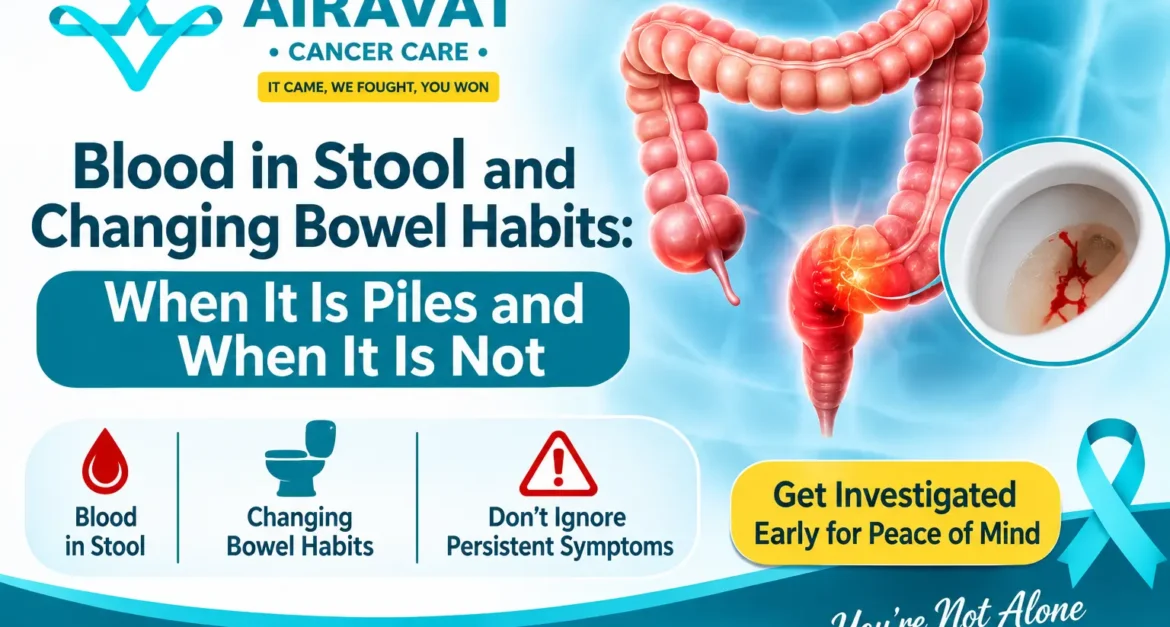
Almost everyone who notices blood in the toilet decides it is piles. Most of the time they are right, which is exactly what makes colorectal cancer so dangerous. The early signs of colon cancer are nearly identical to the symptoms of haemorrhoids, and the reassuring explanation is usually the correct one, right up until the day it is not.
This guide explains how to tell the difference, which symptoms genuinely need investigating, why colonoscopy matters so much in this particular cancer, and what treatment involves. Colorectal cancer is among the most curable cancers when caught early and among the most difficult when caught late, and the distance between those two outcomes is usually measured in months of delay.
Why Colorectal Cancer Is Rising in Younger Adults
Colorectal cancer was long considered a disease of the elderly. That is changing. Cases in adults under fifty have been rising in many countries, including India, and the reasons are not fully understood.
This matters practically, because the assumption that you are “too young for bowel cancer” is now one of the most common causes of late diagnosis. Younger patients are frequently treated for piles or irritable bowel syndrome for a year or more before anyone looks inside.
If your symptoms persist despite treatment, your age is not a reason to stop investigating.
Blood in the Stool: How to Read It
Blood is the symptom everyone notices and nearly everyone misinterprets. Some rough guidance, none of which replaces an examination:
Bright red blood on the paper or on the surface of the stool, with itching or pain, is more typical of haemorrhoids or a fissure. This is the common and usually harmless pattern.
Dark red blood mixed through the stool, rather than coating it, suggests bleeding from higher in the bowel and needs investigating.
Black, tarry stools suggest bleeding from the stomach or small intestine and always require medical assessment.
Blood with no pain at all deserves particular attention, because painless bleeding is less typical of piles.
Here is the rule that matters most: even if you have known haemorrhoids, new or changed bleeding still needs investigating. Having piles does not protect you from also having a polyp or a tumour, and assuming one explains the other is the single most common error in this disease.
Symptoms That Should Prompt a Colonoscopy
See a specialist if any of the following persists for more than two to three weeks:
- A persistent change in bowel habit: new constipation, new diarrhoea, or alternating between them
- Narrow or ribbon-like stools
- A feeling that the bowel does not empty completely after passing stool
- Abdominal pain, cramping or bloating that is new and does not settle
- Unexplained weight loss
- Unexplained iron deficiency anaemia, especially in men and post-menopausal women, which is often the only sign of a slowly bleeding right-sided tumour
- Persistent fatigue with no obvious cause
- A lump felt in the abdomen
Unexplained anaemia deserves emphasis. A right-sided colon tumour can bleed slowly for months without any visible blood in the stool at all. If a blood test shows low iron and nobody can explain why, the bowel needs examining.
How long is too long to wait?
A useful threshold is three weeks. Infections, dietary upsets and flare-ups of irritable bowel syndrome generally settle within that window. A symptom that is still there after three weeks, or that keeps returning, has stopped being self-limiting and has become something that needs an explanation.
The same applies to treatment that is not working. If you have been given ointment for piles or medication for IBS and the symptom persists after a reasonable trial, that is information, not a reason to try a second course of the same thing.
Who Is at Higher Risk
Risk is higher if you have a first-degree relative diagnosed with colorectal cancer, a personal history of polyps, inflammatory bowel disease such as ulcerative colitis or Crohn’s disease, or an inherited syndrome such as Lynch syndrome or familial adenomatous polyposis.
Lifestyle contributes too: smoking, heavy alcohol use, obesity, physical inactivity, and diets high in red and processed meat and low in fibre are all associated with increased risk.
Family history changes your screening schedule substantially, often starting ten years earlier than the general recommendation. If a parent or sibling has had colorectal cancer, tell your doctor explicitly rather than waiting to be asked.
Why Colonoscopy Is Different From Other Cancer Tests
Most screening tests find cancer. Colonoscopy prevents it.
Colorectal cancer almost always begins as a polyp, a small growth on the bowel lining that is not cancer and may take years to become one. During a colonoscopy, polyps found are removed in the same sitting. The cancer that polyp might have become simply never happens.
This makes colonoscopy unusual and genuinely valuable. It is both the diagnostic test and, frequently, the treatment.
What the procedure involves
Colonoscopy is performed under sedation and typically takes under an hour. The preparation, which involves clearing the bowel the day before, is the part most people dislike, and it is also the part that determines whether the test is reliable. Follow the preparation instructions exactly.
Other tests exist, including stool-based tests and CT colonography, and they have a role, particularly for people unwilling or unable to have a colonoscopy. But only colonoscopy allows polyps to be removed during the examination.
When to start screening
Average-risk screening generally begins around age forty-five to fifty, with the interval depending on findings. Earlier and more frequent screening is recommended for those with family history, previous polyps, or inflammatory bowel disease. Ask your doctor what applies to you specifically.
Diagnosis and Staging
If a colonoscopy finds a tumour, a biopsy confirms the diagnosis, and staging determines the treatment.
Staging typically involves CT of the chest, abdomen and pelvis, MRI of the pelvis for rectal tumours specifically, and blood tests including CEA, a tumour marker used mainly to monitor response and follow-up rather than to diagnose.
Molecular testing of the tumour, including mismatch repair or microsatellite instability status and RAS and BRAF mutations, is increasingly standard and directly determines whether certain targeted or immunotherapy drugs will work. Ask whether this testing has been done.
Rectal cancers are staged more intensively than colon cancers because the pelvis is a confined space and the planning is more complex.
Treatment: What the Options Are
Surgery
Surgery is the main curative treatment. The affected segment of bowel is removed along with its lymph nodes, and the two ends are usually rejoined.
Many of these operations are suitable for laparoscopic cancer surgery, which uses small incisions and generally allows faster recovery with equivalent cancer outcomes in appropriate cases. Specialist colorectal cancer surgery matters because the quality of the lymph node clearance and the margins is decided in theatre.
Details of the specific pathways are on our colon cancer and rectal cancer pages.
Will I need a stoma?
This is the question patients are most frightened to ask, so let us answer it directly.
Most people with colon cancer do not need a permanent stoma. For rectal cancer, particularly tumours low in the rectum, a stoma is more likely, and it is often temporary, created to protect a healing join and reversed later.
Ask your surgeon three specific things: whether a stoma is likely in your case, whether it would be temporary or permanent, and what support is available if you need one. Modern stoma care allows a full, active life, and the fear is usually worse than the reality.
Chemotherapy and radiotherapy
Chemotherapy may follow surgery where lymph nodes are involved. For rectal cancer, chemotherapy and radiotherapy are often given before surgery to shrink the tumour and improve the chance of clear margins.
In advanced disease, targeted therapy and immunotherapy are used in selected patients based on molecular testing, and specialised approaches such as cytoreductive surgery with HIPEC may be appropriate where disease has spread within the abdominal cavity.
Follow-Up After Treatment
Follow-up typically includes clinical review, CEA monitoring, periodic CT scans and surveillance colonoscopy. The first surveillance colonoscopy is usually done within a year of surgery, then at intervals based on findings.
Keep going. Recurrence and new polyps are both detectable early, and surveillance is how that happens.
Ask your team for a written follow-up schedule setting out which test is due when, and who to contact if symptoms return between appointments. Recurrences caught on a scheduled scan are frequently still treatable; those found because a patient became unwell often are not.
Frequently Asked Questions
I have piles. Could my bleeding still be cancer?
Yes, and this is the most important point in this guide. Having haemorrhoids does not rule out a polyp or a tumour. Any new, changed or persistent bleeding should be investigated even with a known history of piles.
Is colonoscopy painful?
It is performed under sedation, and most people remember little of it. The bowel preparation beforehand is the genuinely unpleasant part, and it is essential to do it properly, because inadequate preparation can hide polyps.
I am in my thirties. Am I too young for bowel cancer?
No. Colorectal cancer in younger adults has been increasing, and age is one of the commonest reasons diagnosis is delayed. Persistent symptoms deserve investigation whatever your age.
Will I definitely need a permanent stoma?
Most colon cancer patients do not. For rectal cancer it is more likely, and frequently temporary. Ask your surgeon specifically about your case rather than assuming the worst.
How often should I be screened if a parent had colorectal cancer?
Usually earlier and more often than the general population, commonly beginning around ten years before the age at which your relative was diagnosed. The exact schedule depends on who was affected and at what age, so get personalised advice.
Getting Checked in Ahmedabad
If you have had bleeding, a change in bowel habit, or unexplained anaemia for more than a few weeks, get it examined. A colonoscopy that finds a polyp prevents a cancer. A colonoscopy that finds an early tumour usually means surgery alone is enough.
Airavat Cancer Care is a dedicated surgical oncology hospital in Ahmedabad treating GI cancer including colorectal, colon and rectal cancers, alongside head and neck, breast, gynaecological, urological, thoracic and soft tissue cancers.
For wider guidance, see our checklist for choosing the best cancer hospital in Ahmedabad and our guide to cancer treatment cost in Ahmedabad. More patient guides are on our blog.
Further reading: the National Cancer Institute’s colorectal cancer information.
Book a Colorectal Consultation
Bring any colonoscopy, biopsy or scan reports you already have, along with recent blood test results.